
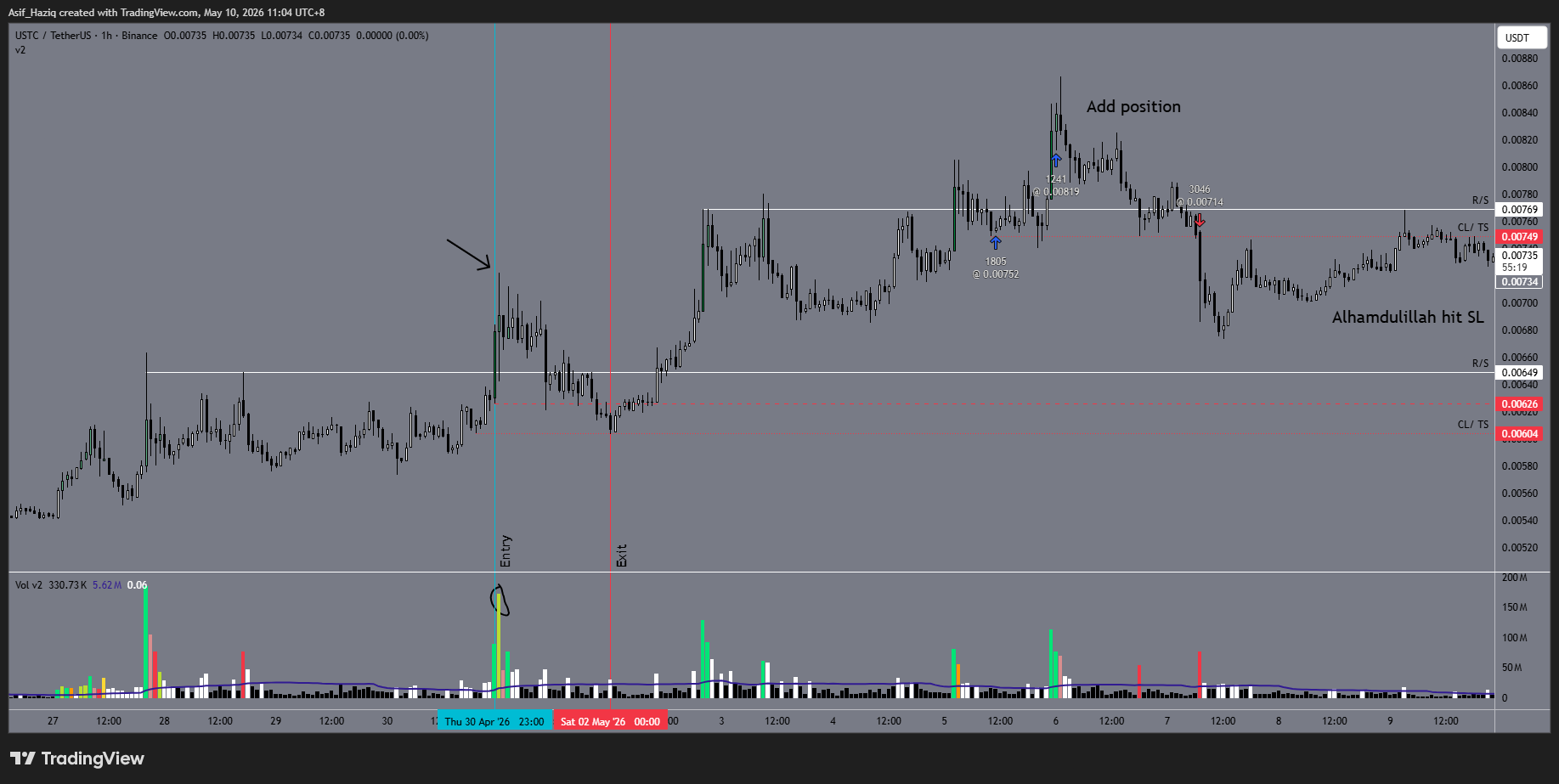
Trade Reconstruction
| Details | |
|---|---|
| Entry | Buy Market @ $0.00658 (May 1, 14:56) |
| SL | Trigger $0.00603, filled $0.00603 |
| Result | -8.4% loss |
| Hold Time | ~10 hours |
| SL Status | ✅ Set immediately, ✅ Never cancelled, ✅ Honoured |
What the Chart Shows
- Entry at $0.00658 was above the horizontal base (~$0.00590–$0.00600 white line) — reasonable location
- Price spiked strongly on entry candle with high volume (yellow bar) — looked like a valid breakout
- But the spike was a single candle exhaustion move — price immediately reversed and sold off
- SL at $0.00603 was hit the same night
- After your exit, price dropped further to ~$0.00600 before recovering strongly — the SL actually saved you from a deeper drawdown
What You Did Well ✅
SL set at the same time as entry — timestamp shows SL order placed alongside the buy. This is now becoming consistent behaviour across CGPT, BIO (partial), USTC #1, and now USTC #2. Four trades in a row with SL in place.
SL not cancelled — no cancellation this time, even though the previous USTC trade you cancelled within 30 seconds. You’re breaking the habit.
SL placement was logical — below the breakout base, not arbitrary.
Accepted the loss cleanly — no record of panic orders or re-entries.
What Went Wrong ❌
1. Entry was into a false breakout / exhaustion spike The entry candle had massive volume but price couldn’t sustain above the base. High volume + immediate reversal = sellers absorbing the breakout, not buyers pushing through. This is a volume trap — the spike looks bullish but the candle closes weak.
On a 1-hour chart, before entering a breakout candle, wait for the candle to close above the level. Don’t market buy mid-candle into a spike.
2. Risk was -8.4% — slightly wide for a failed breakout The SL at $0.00603 vs entry $0.00658 is a 8.4% gap. For a base breakout trade, ideally your SL sits just below the base (which it did), but the entry being chased into the spike candle widened the distance unnecessarily. A limit entry at $0.00620–$0.00630 on a retest would have tightened the stop to ~4–5%.
Leave a Reply