
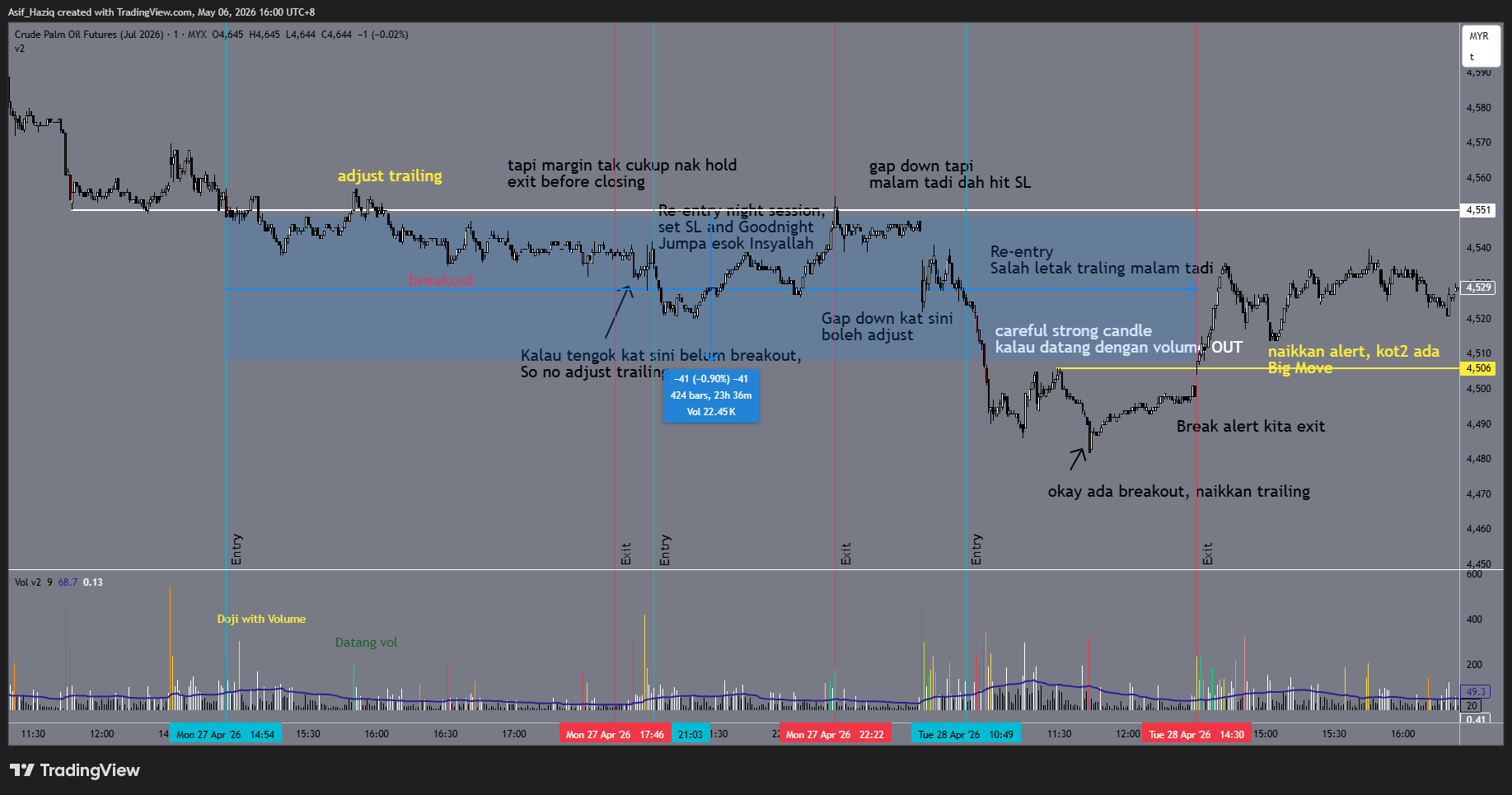
| # | Date | Direction | Entry | Exit | Pts | P&L (MYR) | Rule followed? | Result |
|---|---|---|---|---|---|---|---|---|
| T1 | 27 Apr | Short | 4549 | 4539 | +10 | +250 | Partial | Win |
| T2 | 27 Apr | Short | 4536 | 4549 | −13 | −325 | SL hit | Loss |
| T3 | 28 Apr | Short | 4524 | 4509 | +15 | +375 | Yes | Win |
T1: Exited early — margin pressure. T2: Gap-down re-entry, SL hit next session. T3: Clean breakdown, raised trailing, exited on break-alert.
- Margin management before entry. T1 was cut short because margin wasn’t checked before sizing. Before any trade, confirm: available margin ≥ (SL distance × contract size × buffer). Consider reducing lot size when margin is tight rather than risking forced early exit.
- No trailing SL on overnight re-entries. Trailing SL during a flat/quiet night session is dangerous — a gap open can pierce it instantly. For night session holds, use a fixed SL placed below/above the most recent swing structure, not a dynamic trailing SL.
- Define R:R minimum before entry. None of your 3 trades had an explicit minimum R:R logged. Even a simple rule — “only take trades with at least 1:1.5 R:R” — filters marginal setups and keeps your average winner larger than average loser.
- Volume confirmation on re-entries. Your chart notes already show you watch volume (“careful strong candle kalau datang dengan volume → OUT”). Formalise this: for any re-entry, require volume spike confirmation on the breakout candle before placing the order.
- T3 is your reference trade. Entry on confirmed breakdown, structure-based exit, raised trailing only after confirmation. Document this trade in a playbook and compare all future trades against it.
Here’s the full breakdown of your session:
Overall: Decent session, but T2 was avoidable. You made net +MYR 300 across 3 trades, with 2 wins and 1 loss. The framework is solid — your instincts on volume, structure, and trailing are already good, as shown in T3.
Key takeaways from each trade:
T1 was a win in points but an execution failure — you were forced out by margin, not by your own exit rule. A strategy exit and a margin-forced exit are completely different things, and the latter breaks your system.
T2 was the most instructive loss. The gap-down risk at open is well-known in FCPO, especially around commodity news windows. Setting a trailing SL during a quiet night session and expecting it to hold through a gap is the core problem. Fixed structural SL for overnight holds is the fix.
T3 is your benchmark trade. Entry on confirmed breakdown, raised trailing only after confirmation, exited on alert. Copy this process.
The single biggest lever for improvement is margin discipline before entry — if T1 was sized correctly for your available margin, you’d have held it to a much better exit and your session P&L would look significantly better.
Leave a Reply